Invoice Requirements in Latvia 2026: Mandatory Details
October 8, 2026 · 4 min read
What an invoice is and when you must issue one
An invoice is a source document that the supplier gives the buyer for payment and that proves the transaction took place. In Latvia, two laws set the requirements, and your VAT status decides which one applies:
- VAT invoice (PVN rēķins) – issued by registered VAT payers. The mandatory details are set by Article 125 of the VAT Act; issuing rules and deadlines by Articles 127–133.
- Invoice without VAT – issued by anyone not registered for VAT: for example, self-employed persons, micro-enterprise tax payers or limited companies (SIA) whose turnover in a calendar year stays within the EUR 50,000 registration threshold (Article 59 of the VAT Act). The minimum details are set by Article 11(5) of the Accounting Act.
A VAT payer issues a VAT invoice for every supply of goods or services and for every advance payment received (Article 127 of the VAT Act). For private individuals, a VAT invoice is only required if the buyer asks for one; in retail, a till receipt normally documents the sale. If the value of a transaction excluding VAT is below EUR 150, you may issue a simplified VAT invoice with fewer details (Article 126).
Mandatory details of a VAT invoice (Article 125 of the VAT Act)
- Document title, for example "Rēķins" (Invoice) – required by the Accounting Act.
- Date of issue.
- A sequential number in one or more series that identifies the invoice uniquely.
- Supplier's name and registered address (for an individual: first name, surname and declared place of residence).
- Supplier's VAT registration number (LV + 11 digits).
- Customer's name and registered address (for an individual: first name, surname and declared place of residence).
- Customer's VAT registration number, if the customer is registered for VAT in Latvia or another EU country.
- Date of supply or of receipt of the advance, if it differs from the date of issue.
- Name of the goods or services, quantity and unit – specific, not just "services".
- Unit price excluding VAT.
- Discounts, if not already deducted from the unit price.
- VAT rate applied – 21%, 12%, 5% or 0%.
- VAT amount.
- Total excluding VAT – separately for each rate and for exempt transactions.
- Special notes where relevant: a reference to the article of the Act or the VAT Directive when the 0% rate or an exemption applies; "nodokļa apgrieztā maksāšana" (reverse charge) when the customer pays the VAT; "naudas līdzekļu uzskaite" (cash accounting); "peļņas daļas režīms …" (margin scheme); "pašaprēķins" (self-billing) when the customer issues the invoice.
Article 125 does not explicitly require the total payable including VAT, but you cannot do without it – the buyer needs to see what to pay. Amounts may be shown in any currency, but the VAT amount must be in euro (Article 129(5)). The same details apply to an electronic invoice: only the form differs, not the content. A VAT invoice may be issued electronically if the customer accepts that form (Article 132).
Invoice without VAT: what to include if you are not a VAT payer
Article 11(5) of the Accounting Act sets the minimum for a source document:
- document type, date and number;
- supplier's name and registration number (for an individual who is not a sole trader: first name, surname and taxpayer registration code);
- the same details for the customer; if the customer is a private individual – first name and surname, with the personal identity number only at their request or where another regulation requires it;
- a description of the transaction and its value in money, plus quantity and unit where regulations require them.
The law does not require an address or the note "Nav PVN maksātājs" (not a VAT payer), but both are worth adding: the address helps the customer's bookkeeping, and the note shows at once that no input VAT can be deducted.
The most common mistake: writing "VAT 0%" on an invoice without VAT. This is wrong – the 0% rate is applied only by registered VAT payers to specific transactions, such as exports or supplies of goods to a VAT payer in another EU country. If you are not a VAT payer, leave the VAT line out entirely.
Issue an invoice with or without VAT for free with NUMBERO
Invoice sample
This is what a completed VAT invoice for a service looks like:
- Invoice No. NUM 2026-0042, issued 5 March 2026.
- Supplier: SIA "Piemērs", Brīvības iela 1, Rīga, LV-1010; VAT No. LV40000000000.
- Customer: SIA "Klients", Ganību dambis 2, Rīga, LV-1045; VAT No. LV40000000001.
- Service period: 1–28 February 2026.
- Service: website maintenance, 10 h × EUR 50.00 = EUR 500.00.
- VAT 21%: EUR 105.00.
- Amount payable: EUR 605.00, due 19 March 2026.
An invoice without VAT would carry the same data, only without the VAT numbers and the VAT line, with EUR 500.00 payable. Ready-made layouts are covered in Invoice templates: where to find them and how to use them.
Numbering
- Every VAT invoice needs a sequential number in one or more series that identifies it uniquely. In practice invoices are numbered consecutively – 1, 2, 3 – because a gap prompts the question "where did that invoice go?" in a tax audit.
- Series are optional but handy: a separate series per line of business or per year (for example "NUM 2026-0001"). If the year is part of the series, numbering can restart every year.
- An invoice issued in error and not yet sent is cancelled, not deleted: a cancelled VAT invoice must be kept in the books to explain the missing number (Article 129(6) of the VAT Act).
- An invoice already sent is not edited – you issue a credit note or another document that amends the original invoice and refers to it unambiguously (Article 125(5)).
- NUMBERO assigns numbers automatically from the template you choose, so gaps and duplicates do not happen.
When to issue and how long to keep
- A VAT invoice is issued no later than the 15th day after the transaction or the receipt of an advance (Article 131(1) of the VAT Act).
- For supplies of goods to a VAT payer in another EU country and for services where the customer in another EU country pays the VAT – no later than the 15th day of the following month (Article 131(2)).
- Several supplies within one month can be covered by a single summary invoice (Article 129(1)). For continuous supplies, you invoice per period, but the transaction is deemed to take place at least once every six months (Articles 31(2) and 32(3)).
- VAT invoices are kept for five years from the date of issue (Article 133 of the VAT Act); other source documents for at least five years (Article 28 of the Accounting Act).
Advance invoice
A VAT payer must issue a VAT invoice for an advance payment received (Article 127(1), point 2). In practice there are two routes:
- VAT invoice requesting an advance – issued before payment with all the Article 125 details; it is an ordinary VAT invoice with its own number. The VAT on the advance is reported in the period in which the money is received (Article 120(2)).
- Payment request or pro forma invoice that is not a VAT invoice. In that case, once the advance arrives, you must issue a VAT invoice for the amount received no later than the 15th day, stating the date the advance was received.
After delivery, you issue the final invoice for the whole transaction and deduct the advance already taxed and its VAT, so the tax is not charged twice. Exception: no VAT invoice is required for an advance received for a supply of goods to another EU country. If you are not a VAT payer, an advance invoice is an ordinary invoice without VAT.
Electronic invoice and e-invoice
An electronic invoice (for example, a PDF sent by email) contains the same as a paper invoice. An e-invoice, or structured electronic invoice, is an XML file following the EN 16931 standard that the customer's system reads automatically (Article 1 of the Accounting Act).
- Invoices to public budget institutions must already be structured e-invoices, and since 1 January 2026 the data of these e-invoices must be passed to the State Revenue Service, VID (Article 11(14) of the Accounting Act and point 10 of its transitional provisions; the procedure is set by Cabinet Regulation No. 749).
- From 1 January 2028, structured e-invoices will also be mandatory for invoices to other companies registered in Latvia, and from the same date their data will also have to be passed to VID.
From the same invoice, NUMBERO generates a structured XML e-invoice under PEPPOL BIS Billing 3.0 / EN 16931 alongside the PDF, and the free e-invoice reader opens and validates XML files you receive. More on the E-invoices page.
Common mistakes
- No customer VAT number even though the customer is a VAT payer – this makes deducting input VAT harder.
- "Services" instead of a specific description.
- An invoice in another currency without the VAT amount in euro.
- "VAT 0%" written on an invoice without VAT.
- Skipped or repeated numbers with no cancelled invoice on file.
- No date of supply where it differs from the date of issue.
- No VAT invoice issued within 15 days of receiving an advance.
Frequently asked questions
Does a self-employed person have to issue invoices?
Every transaction needs a source document. To a company or another business you issue an invoice; when selling to a private individual, a till receipt can document the sale, while a VAT payer issues a VAT invoice if the buyer asks. If you are not a VAT payer, issue an invoice without VAT showing your taxpayer registration code.
How does an invoice differ from a VAT invoice?
Only registered VAT payers issue VAT invoices, and these must show VAT numbers, the rate and the tax amount. Invoices without VAT are issued by those who are not VAT payers; they have no tax line.
Can I invoice in a foreign currency?
Yes, but the VAT amount must also be shown in euro at the European Central Bank euro reference rate in force at the start of the day of the transaction or of receipt of the advance (Article 129(5) of the VAT Act, Article 7 of the Accounting Act).
Does an invoice need a signature?
Usually not. The Accounting Act allows an invoice without a signature if the transaction is evidenced by a contract or another legally valid document, or if the customer approves the invoice under its own internal procedure (Article 11(7) and (8)). The authenticity of a VAT invoice can also be ensured without an electronic signature (Article 132 of the VAT Act).
How do I correct a mistake in an invoice already sent?
Issue a credit note or debit note referring to the original invoice number and date. The original invoice is neither edited nor deleted. The step-by-step process is in How to issue an invoice: a simple guide.
Is a PDF invoice sent by email an e-invoice?
No. An e-invoice is a structured XML file under the EN 16931 standard; a PDF is merely an electronic form of an invoice and does not meet the requirements for structured e-invoices.
Keep reading
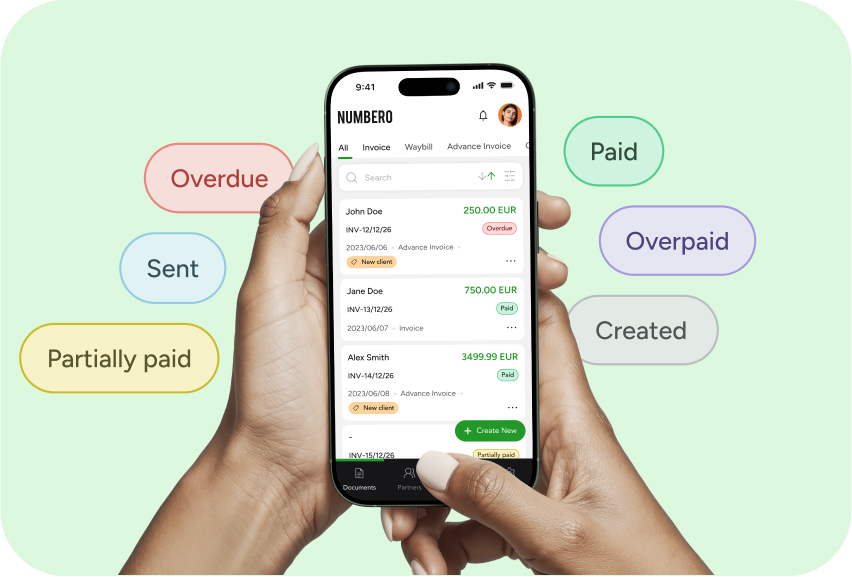
What is an E-Invoice? Numbero Experts Weigh In
Fed up with office shelves bursting with paper invoices? It's time to consider switching to e-invoices. Explore their benefits in this article.
Oct 6, 2026 · 2 min read
Self-Employed or SIA in Latvia 2026: Choose by Profit
Self-employed or SIA? Compare taxes, liability, costs and how you use your profit to choose the right business form for your work in Latvia in 2026.
Aug 5, 2026 · 7 min read
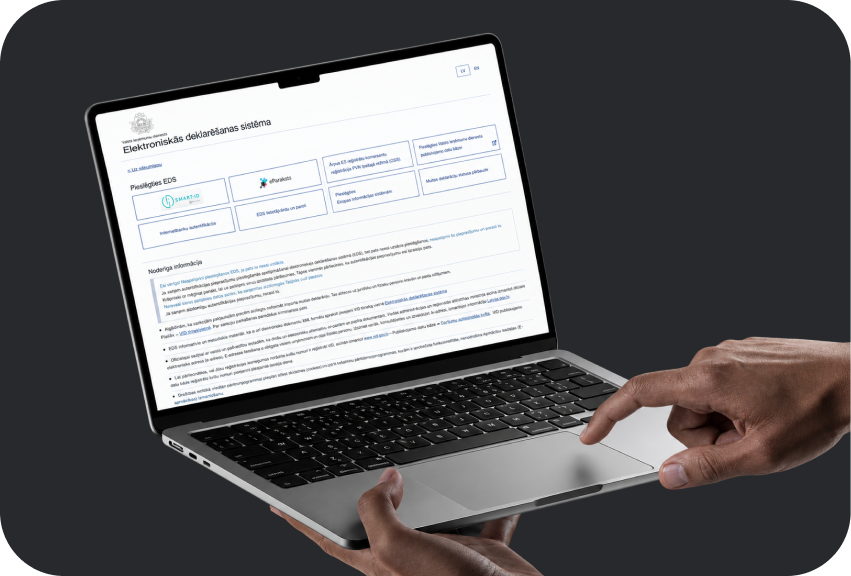
Self-Employed Registration in Latvia (VID EDS) 2026
How to register as self-employed with VID in Latvia in 2026: the free EDS application, choosing a tax regime, first invoices, and IIN, VSAOI and VAT duties.
Jul 28, 2026 · 6 min read