Self-Employed or SIA in Latvia 2026: Choose by Profit
August 5, 2026 · 7 min read
It is easy to choose the wrong business form if you only look at the total of the invoices you issue. Expenses, how much money you need for personal spending, risk and growth plans matter more.
The question "self-employed or SIA" often comes up for freelancers and small service providers. Self-employed status is usually simpler at the start, while an SIA is a better fit if you plan to reinvest profit, sign larger contracts or your work carries higher risk.
The choice is not irreversible, but changing your business form later means a new registration, re-signing contracts and extra administrative work.
Key takeaways
- Self-employed status is usually the better fit if you work alone, the risk is low and you regularly use most of the profit for personal needs.
- An SIA is often more advantageous if you keep profit in the company, plan to reinvest it, take on larger obligations or want to separate your personal assets from business risks.
- Base the choice on profit after reasonable expenses, not on turnover alone. Also weigh cash flow, how you will pay yourself (salary or dividends) and administration costs.
- Before registering, prepare a plan for at least 12 months covering revenue, expenses, use of profit and your personal cash needs, and check your tax and VAT obligations.
Self-employed or SIA: the basic differences
A self-employed person (pašnodarbinātais) is an individual who has registered an economic activity with the State Revenue Service (VID) and earns income in their own name. An SIA (sabiedrība ar ierobežotu atbildību), a limited liability company, is a legal entity with its own contracts, assets, accounting and tax obligations.
A sole trader (individuālais komersants, IK) is a separate business form registered with the Register of Enterprises (Uzņēmumu reģistrs), not another name for self-employed status.
No single criterion automatically makes an SIA the better deal. If you need most of what you earn for everyday spending, self-employed status is often more convenient. If you plan to keep the profit in the business, an SIA may give you more options.
Registration and getting started
A self-employed person registers their activity free of charge in the VID Electronic Declaration System (EDS) and chooses a tax regime when registering: the general regime or the micro-enterprise tax. There is no need to set up a separate company or pay in share capital. Our guide to registering as self-employed with VID explains the process step by step.
VID explains the conditions of both regimes in its guidance for people carrying out economic activity (in Latvian).
To found an SIA, you need to draw up founding documents, pay in the share capital and file an application with the Register of Enterprises. The minimum share capital of a standard SIA is 2,800 EUR. The Commercial Law also allows a low-capital SIA with share capital below 2,800 EUR, but it comes with additional conditions: only individuals can be members, and at least 25% of each year's profit must go into a mandatory reserve.
A self-employed person can usually start working sooner because registration is simpler. An SIA takes more preparation, but contracts are signed and assets acquired by the company, not by you personally.
Liability for debts and contracts
A self-employed person is liable for their obligations with all of their assets. If a client claims damages or a debt arises, the risk can reach your personal savings as well.
An SIA member's risk is usually limited to what they have invested in the company. Still, limited liability is not complete protection: a personal guarantee or dishonest conduct can lead to personal liability, and a board member can be held liable for breaching their duties.
That is why an SIA makes particular sense if you handle large orders, store client data, sell goods or take on long-term contractual obligations.
Taxes in 2026: profit matters more than turnover
Taxes for a self-employed person and an SIA cannot be compared by a single rate, because the tax regime determines both the tax base and how you declare. Look at how much is left after expenses, how much you pay yourself as salary or dividends, and how much you leave in the company for growth.
Self-employed: IIN, VSAOI and the micro-enterprise tax
Under the general regime, a self-employed person's personal income tax (iedzīvotāju ienākuma nodoklis, IIN) is calculated on business profit, not on total revenue. Profit is revenue minus documented business expenses.
Business expenses can include, for example, software you use for work, materials, premises rent, professional insurance and travel related to client work. If you also use a purchase privately, only the business share may be counted as an expense. Social insurance contributions you have paid also count as expenses.
IIN is calculated once a year in the annual income tax return. In 2026, the IIN rate is 25.5% on annual income up to 105,300 EUR and 33% on the part above that threshold. Taxable income is reduced by the annual non-taxable minimum (6,600 EUR) and by eligible expenses (attaisnotie izdevumi), such as education and medical costs. You can estimate your tax with our self-employed tax calculator.
Mandatory state social insurance contributions (VSAOI) are calculated for each month but declared once a quarter in the self-employed report (pašnodarbinātā ziņojums), due by the 17th of the month after the quarter. If monthly income is at least 780 EUR (the 2026 minimum wage), you pay 31.07% on at least 780 EUR, plus 10% for pension insurance on the part of income above 780 EUR. You may also choose to pay 31.07% on all of your income. If monthly income is below 780 EUR, you pay only the 10% pension contribution.
Instead of the general regime, a self-employed person can choose the micro-enterprise tax (mikrouzņēmumu nodoklis, MUN). It is 25% of turnover, not of profit, and covers both IIN and social contributions. MUN is available if turnover in the calendar year does not exceed the VAT registration threshold of 50,000 EUR. If you go over it, you must register for VAT and lose MUN status from the following year. MUN is simple, but expenses do not reduce the tax base. So MUN can be convenient for a designer with low expenses, but it can be unprofitable for a craftsperson with expensive materials. An SIA cannot pay MUN.
SIA: UIN, salary and board member obligations
An SIA pays corporate income tax (uzņēmumu ienākuma nodoklis, UIN) mainly when it distributes profit as dividends or has deemed profit distributions, such as expenses unrelated to the business. As long as profit stays in the company and is reinvested, no UIN is due on it.
The UIN rate is 20% of the gross amount: the taxable base is divided by a coefficient of 0.8. In practice, for a member to receive 100 EUR in net dividends, the company pays 25 EUR in UIN, and no IIN is then due on those dividends. Since 2026, dividends paid to members who are individuals can also be taxed under an alternative model: 15% UIN plus 6% IIN. Either way, dividends are not the same as a monthly salary.
If you pay yourself a salary or board member remuneration, the SIA must calculate payroll taxes: VSAOI and IIN. Our salary calculator gives a rough estimate of the net amount and employer costs.
A board member does not have to be paid, but the law "On Personal Income Tax" (Par iedzīvotāju ienākuma nodokli) provides for deemed income. If an SIA's monthly turnover exceeds five minimum wages (3,900 EUR in 2026) and no employee or board member receives at least the minimum wage that month, the board member is deemed to have earned 780 EUR. The SIA must calculate and pay IIN and VSAOI on that amount. The rule does not apply in the calendar year in which the SIA is registered with the Register of Enterprises.
The tax advantage of an SIA shows when you leave part of the profit in the company instead of regularly taking it out for personal spending.
Cash flow shows which option pays off
Say your monthly turnover is 4,000 EUR and reasonable expenses are 300 EUR. Profit before tax is 3,700 EUR. If you mostly spend this money on living costs, the self-employed model is often easier to follow, because taking money out for yourself does not trigger a separate tax. In an SIA, the same money has to be paid out as salary or dividends, and both are taxed.
With 7,000 EUR in revenue and 3,000 EUR in expenses, the picture can look different. If you want to set aside 2,000 EUR of the 4,000 EUR profit for future spending on advertising, equipment or hiring an employee, an SIA can keep that amount in the company without UIN as long as the profit is not distributed. A self-employed person pays IIN and VSAOI on all profit, whether the money is withdrawn or left in the account. So what matters is not only the tax burden, but also your cash needs, administration and growth plan.
An SIA is also a better fit if clients require a contract with a legal entity or if you plan to bring in a partner. On the other hand, accounting costs, the annual report and board duties have to be included in the annual budget. If you want to do business in your own name, a sole trader (IK) is also an option, but it does not give the same liability protection as an SIA.
Invoices, waybills, VAT and e-invoicing
Under both forms you must keep supporting documents and keep private expenses separate from business expenses. An invoice records a payment claim, while a waybill (pavadzīme) or other proof of delivery records the handover of goods.
You must register as a value added tax payer (pievienotās vērtības nodoklis, PVN) once your transactions exceed 50,000 EUR in a calendar year. Since 2025, the threshold is assessed per calendar year rather than over any 12-month period, and some VAT-exempt transactions also count toward it. You may have to register earlier, regardless of turnover: if you provide services to a business registered in another EU country, receive services from a foreign company not operating in Latvia, or your purchases of goods from other EU countries reach 10,000 EUR in a year. A VAT payer charges VAT on invoices and declares it to VID.
The exchange of structured e-invoices and the submission of their data to VID are governed by Cabinet Regulation No. 749. E-invoices are already mandatory for invoices to state and municipal institutions, and they become mandatory between businesses from 1 January 2028. Until then, you can send e-invoices and their data to VID voluntarily. You can issue and manage invoices with Numbero, and what you need to know about e-invoicing now is explained on our structured e-invoice requirements page.
When it makes sense to combine both statuses
When answering "self-employed or SIA", you don't have to assume that only one status is possible. One person can be an SIA member and board member while carrying out another activity as self-employed.
In that case, the contracts, invoices, expenses and tax obligations of each activity must be kept separate. Board work should not be dressed up as a self-employed service to your own SIA. However, for a genuinely separate service, such as design or consulting, you can sign a contract if the price matches the market price and the transaction is real.
The choice starts with a profit plan
Choose self-employed status if you work alone, the risk is low and you regularly use the money for personal needs. Set up an SIA if you reinvest profit, take on larger obligations or plan to hire more people.
Before registering, prepare a 12-month plan of revenue, expenses, use of profit and personal cash needs. It will show whether you will spend the profit or invest it in the business, and both registration and ongoing administration will depend on that.
Working in your own name makes for a simpler start. A company lets you grow by building up capital and keeps your personal assets separate from business risks.
Frequently asked questions
Can a self-employed person set up an SIA?
Yes, a self-employed person can set up an SIA and be its member and board member. The revenue, expenses, contracts and tax records of each activity must be kept separate.
Is an SIA always better for taxes?
No. If you regularly take all the profit out for yourself, the SIA has to pay taxes on the salary or dividends, plus accounting and annual report costs. A self-employed person's profit has already been taxed with IIN and VSAOI, and taking the money out triggers no extra tax. An SIA often becomes more advantageous when you leave part of the profit in the company for growth.
Do I only have to pay VAT once turnover exceeds 50,000 EUR?
No. The 50,000 EUR annual threshold is the general rule, but you may have to register for VAT earlier, for example if you provide services to businesses in other EU countries or receive services from foreign companies.
Keep reading
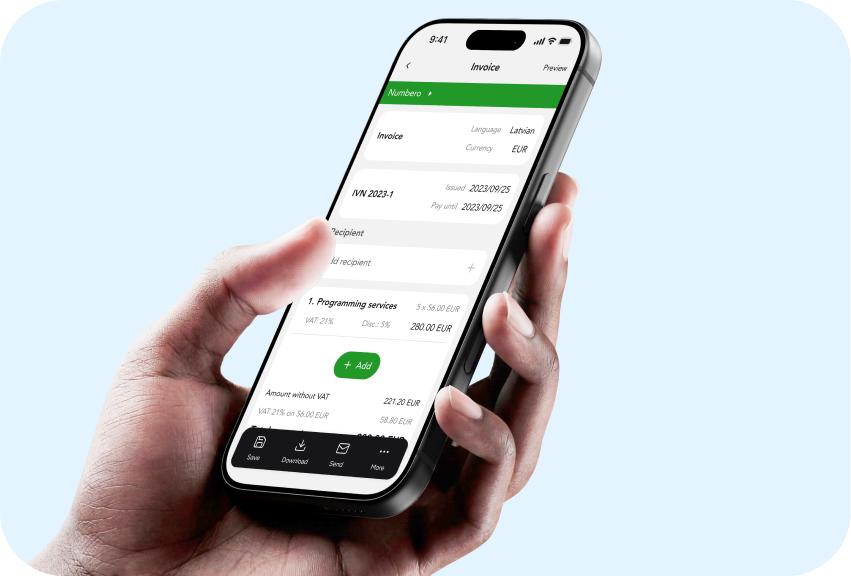
Invoice Requirements in Latvia 2026: Mandatory Details
What a VAT invoice and a non-VAT invoice must show in Latvia in 2026: Article 125 details, numbering, the 15-day deadline, advances, e-invoices and a sample.
Oct 8, 2026 · 4 min read
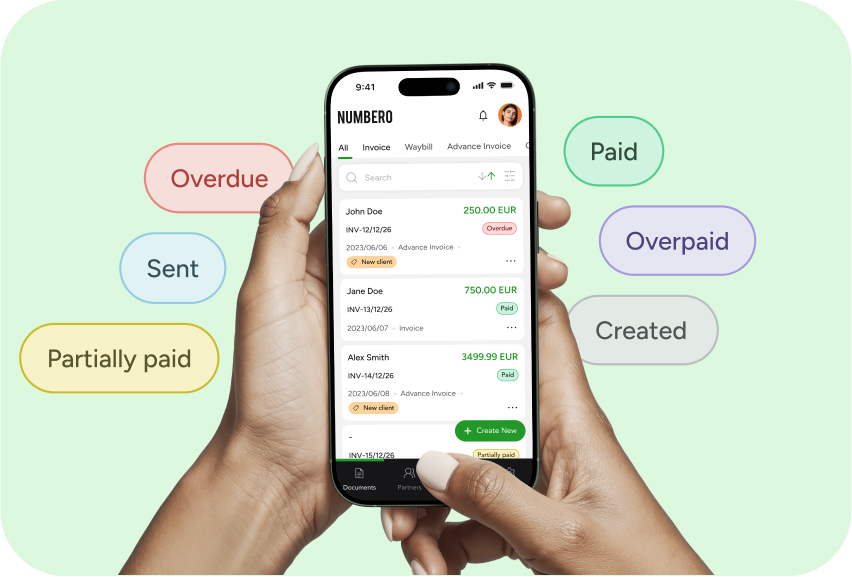
What is an E-Invoice? Numbero Experts Weigh In
Fed up with office shelves bursting with paper invoices? It's time to consider switching to e-invoices. Explore their benefits in this article.
Oct 6, 2026 · 2 min read
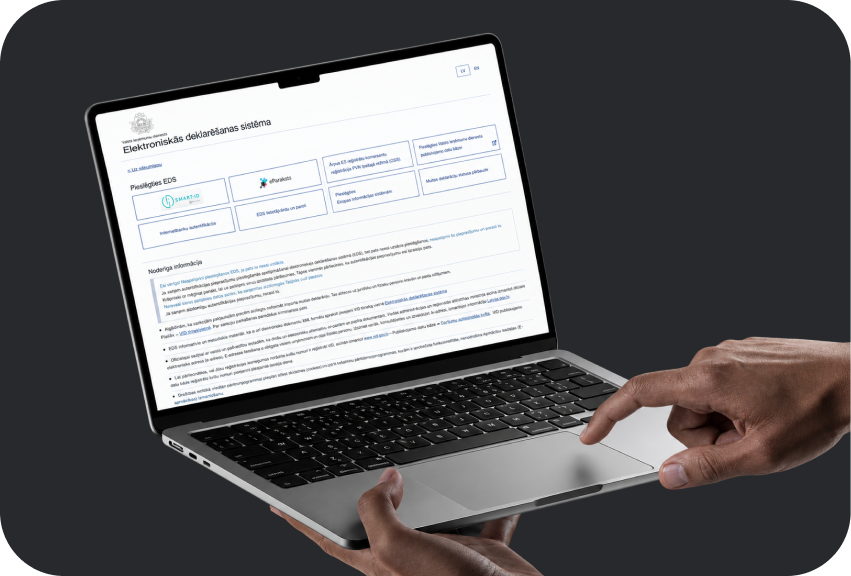
Self-Employed Registration in Latvia (VID EDS) 2026
How to register as self-employed with VID in Latvia in 2026: the free EDS application, choosing a tax regime, first invoices, and IIN, VSAOI and VAT duties.
Jul 28, 2026 · 6 min read